USING FF- EPS INSULATION AS THERMAL INSULATION FOR ROOFS
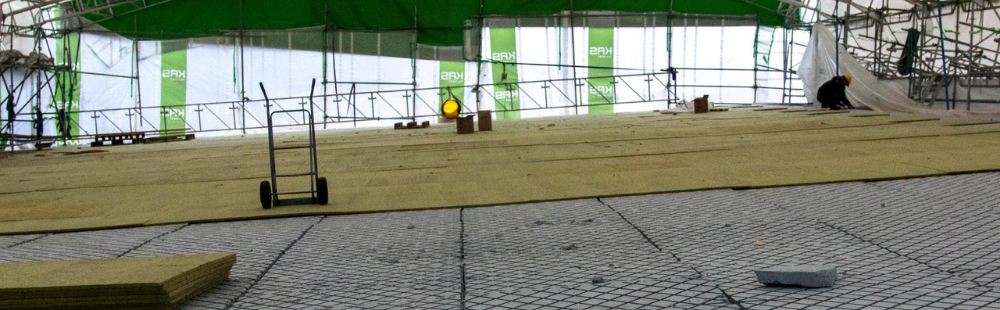
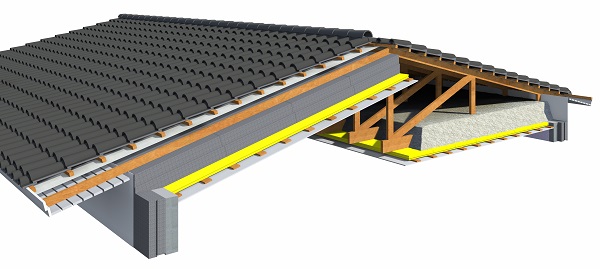
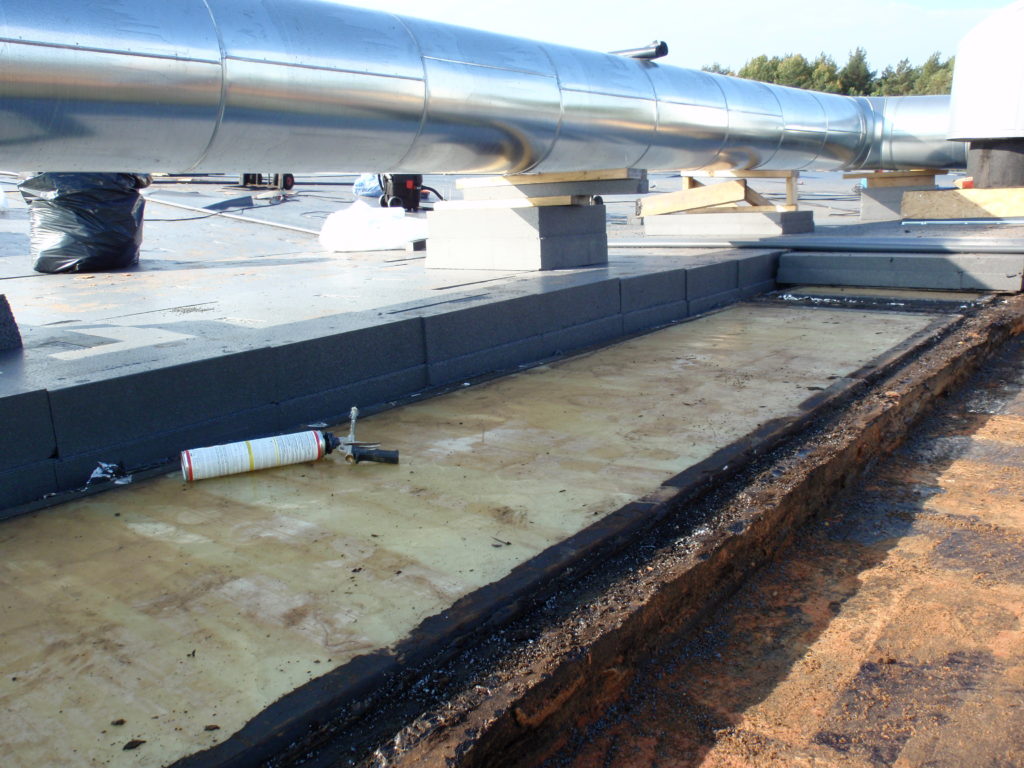
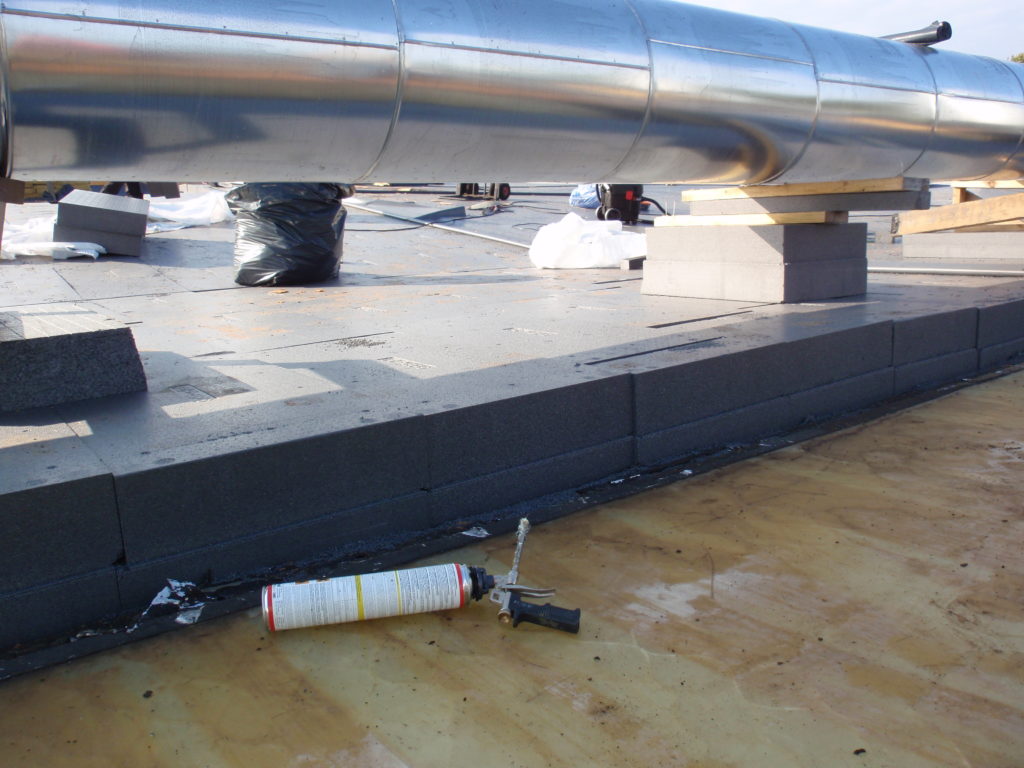
Insulating a low pitch roof using FF-EPS X 60S insulation, which is covered by a layer hard wool as backing for the roofing sheets.
Designed for insulating ceilings and roofs, FF-EPS is highly cost-effective and safe in terms of moisture performance, with a declared thermal conductivity of 0.031 W/mK. FF-EPS insulation products are suitable for new construction, low-energy, passive, and zero-energy construction, as well as for renovation and supplementary thermal insulation of older buildings.
FF-EPS insulation products are excellently suited for use with different frame materials in roofs. The frame could consist of wood, steel, concrete, or lightweight concrete (Siporex). Structures that are thermally insulated with FF-EPS always require a separate air or vapor barrier layer, as the product does not have a high enough water vapor resistance to function as vapor barrier on its own. A vapor barrier can be constructed using FF-PIR thermal insulation products or traditional membrane-type solutions. The locking tongue and groove edge profile of the FF-EPS panels provides an easy way to ensure that the thermal insulation is continuous and leak-proof. It is not necessary to apply PU foam to tongue and groove joints, but any lead-throughs, for example, should still be sealed with an elastic PU foam sealant. FF-PIR polyurethane insulation is also commonly used for low pitch roofs.
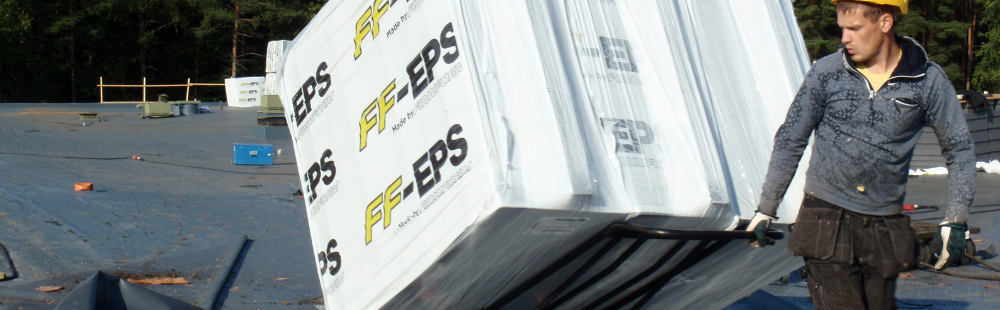
The lightweight FF-EPS insulation is easy to move from one place to another at the worksite.
THE BEARING ROOF STRUCTURE DETERMINES THE INSULATION SOLUTION
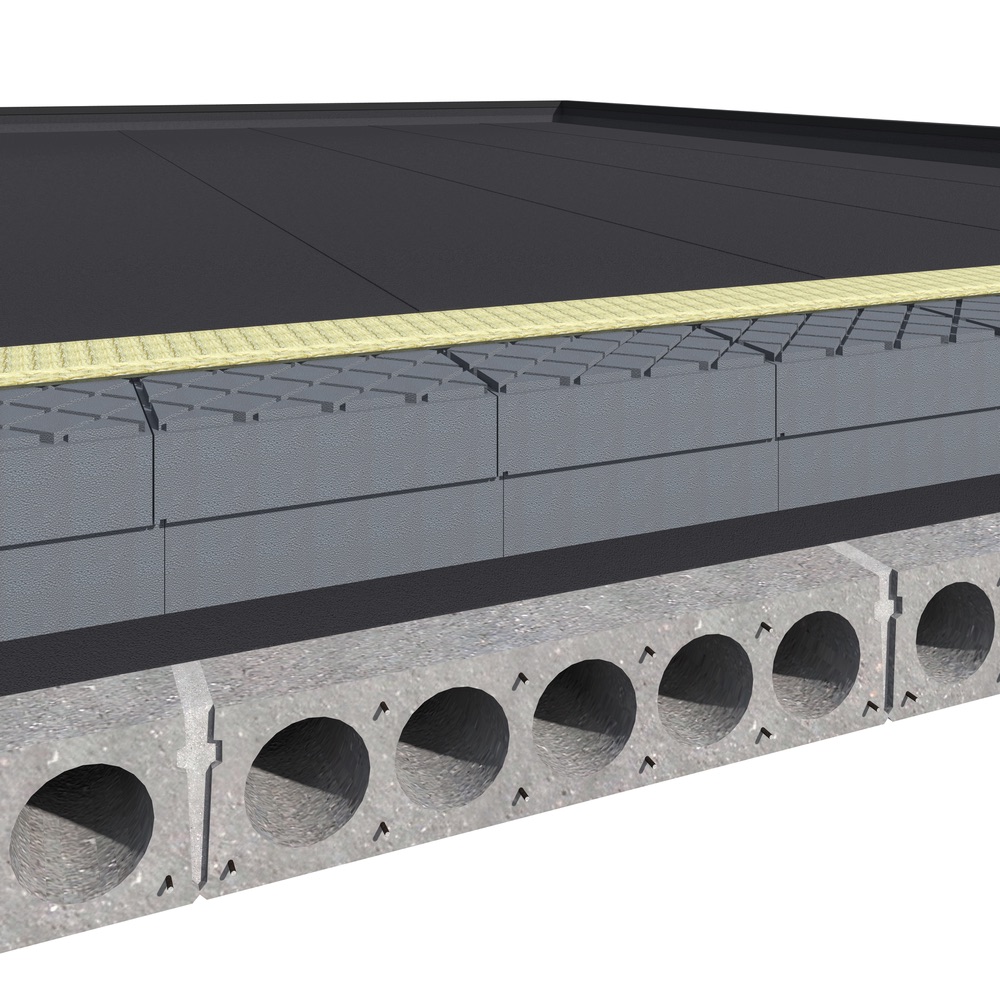
FF-EPS insulation products are compatible with all commonly used roof framework materials. FF-EPS is a highly cost-effective thermal insulation material for flat and sloped roofs. For example, a U value of 0.09, which is the current requirement for roofs, can be achieved with a structure consisting of a hollow-core slab, vapor barrier, FF-EPS X 60S/320 mm, a 20-mm bearing layer of wool, and roofing. This construction ensures that the overall thickness of the structure remains at a reasonable level and eliminates the tracking risk on the roof even around access points. Today, a significant number of technical equipment is placed on roofs, which requires moving about on the roof, and thus the thermal insulation materials used on flat or low pitch roofs must be able to withstand this stress without tracking. The sturdy thermal insulation products manufactured by Finnfoam Oy (FINNFOAM, FF-EPS, FF-PIR) eliminate the tracking risk.
FF-EPS X 60S/320 mm.
NEW FF-EPS 60S SILENT
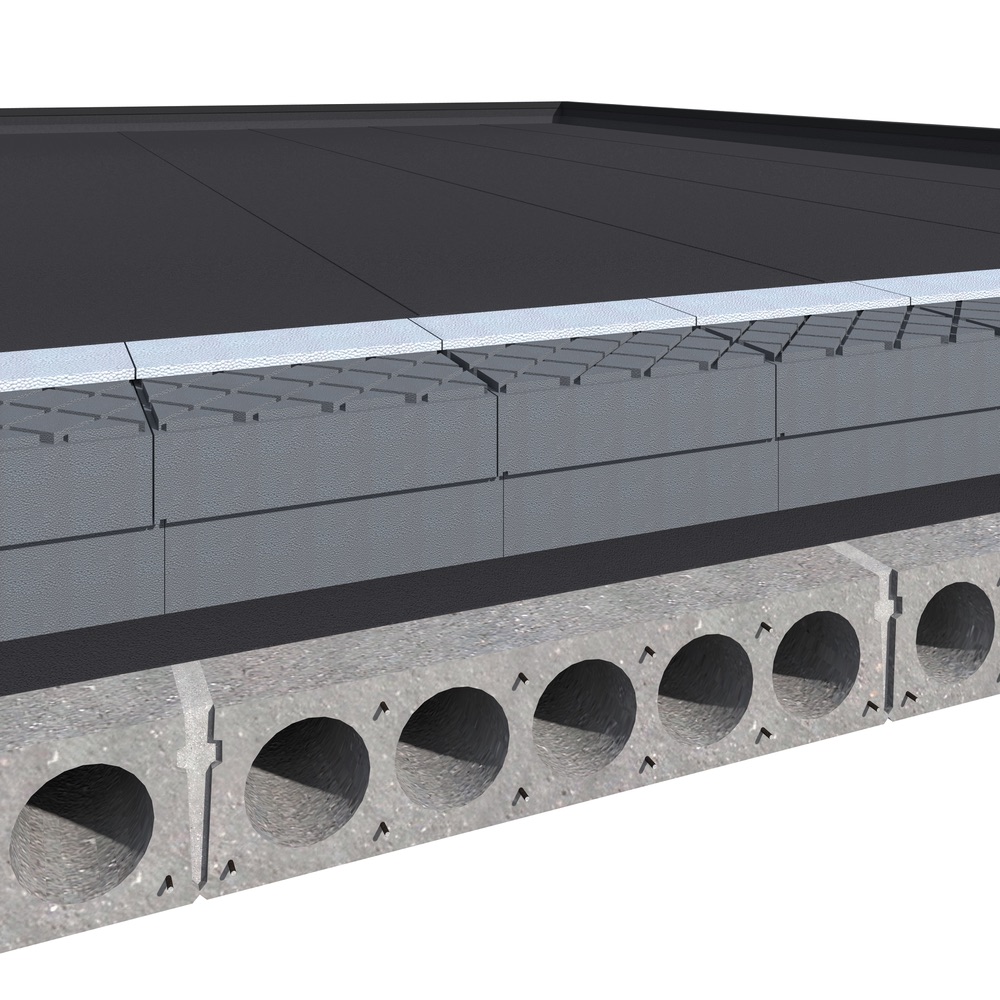
FF-EPS 60S SILENT has an insulation thickness of 320 mm, with a total thickness of 330 mm.
The FF-EPS 60S SILENT panels are coated on one side with a 15–20 mm thick special layer that offers excellent sound-proofing and fire resistance and is suitable for use as a base for cladding. FF-EPS 60S SILENT panels have a deep 10 mm grid pattern below the coating, which is intended to function as a network of ventilation channels on low pitch roofs. FF-EPS 60S SILENT reduces the cubic volume of material lifted on to the roof and allows for faster installation. The required U value of 0.09 can be achieved with a single 320-mm thick panel, which allows for faster roof construction.
PRODUCT VIDEO:
SLOPING TIMBER STRUCTURES
For sloping timber structures, the most effective roof solution with minimal thermal bridging can be achieved if the FF-EPS insulation is installed as a continuous layer on top of the load-bearing structure. With glued laminated beams, it is also possible to utilize a structure where FINNFOAM or FF-PIR panels are installed on the bottom surface of the joists as a vapor barrier, and FF-EPS panels with the thickness required to reach the desired U value are foam sealed in between the joists.
The thickness of insulation is determined based on the desired U value. The below chart presents some example structures.
Framework
Insulation/framework
FF-PIR
U value W/m2K
Hollow-core slab
Insulation on top of hollow-core slab
FF-EPS X 60S/200 mm + 20–30-mm bearing layer of wool
0,14
Hollow-core slab
Insulation on top of hollow-core slab
FF-EPS X 60S/320 mm + 20–30-mm bearing layer of wool
0,09
Hollow-core slab
Insulation on top of hollow-core slab
FF-EPS X 60S/400 mm + 30-mm bearing layer of wool
0,07
Hollow-core slab
Insulation on top of hollow-core slab
FF-EPS 60S X SILENT 320mm
0,09
Double T-slab
Insulation on top of slab
FF-EPS 60S/320 mm + 20–30-mm bearing layer of wool
FF-EPS insulation products are excellently suited for use as supplementary thermal insulation for concrete sandwich element structures in repair construction. Installed on the outside of a structure, FF-EPS ETICS insulation products can also be used as a base for a new coat of render on the facade. The recommended insulation thickness for supplementary thermal insulation is 100 mm, and projects are typically carried out using 200 mm of supplementary thermal insulation. During a facade renovation, the insulation costs are marginal compared to rendering the new facade, which means that supplementary thermal insulation should be maximized wherever possible. The smaller the U value of a structure is, the lower the heating costs will be in the future.
Old low pitch roofs are typically equipped with quite limited thermal insulation. For this reason, at least 200 mm of supplementary thermal insulation is usually added to low pitch roofs. The supplementary insulation can be implemented using standard FF-EPS insulation panels that are covered with a bearing layer of wool and the new roofing, or you can choose to use FF-EPS SILENT, which features a SILENT surface layer that provides an incompressible and fire safe base for roofing by itself. The SILENT coating also provides an optimal foundation for solar panels and other technical equipment that is often installed on modern roofs.
USING FF-EPS INSULATION AS THERMAL INSULATION FOR EXTERIOR WALLS
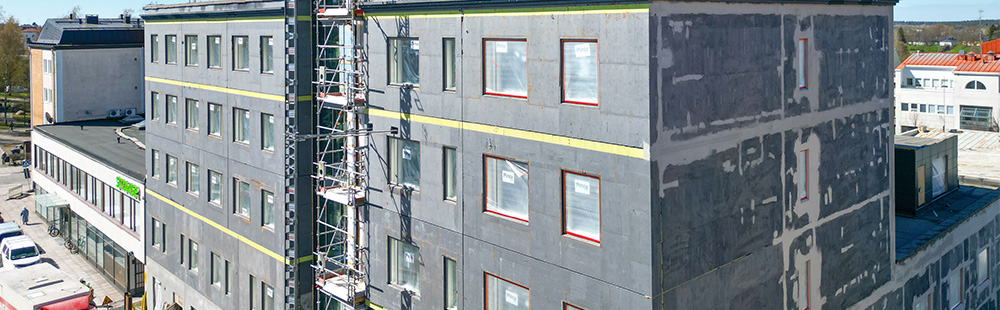
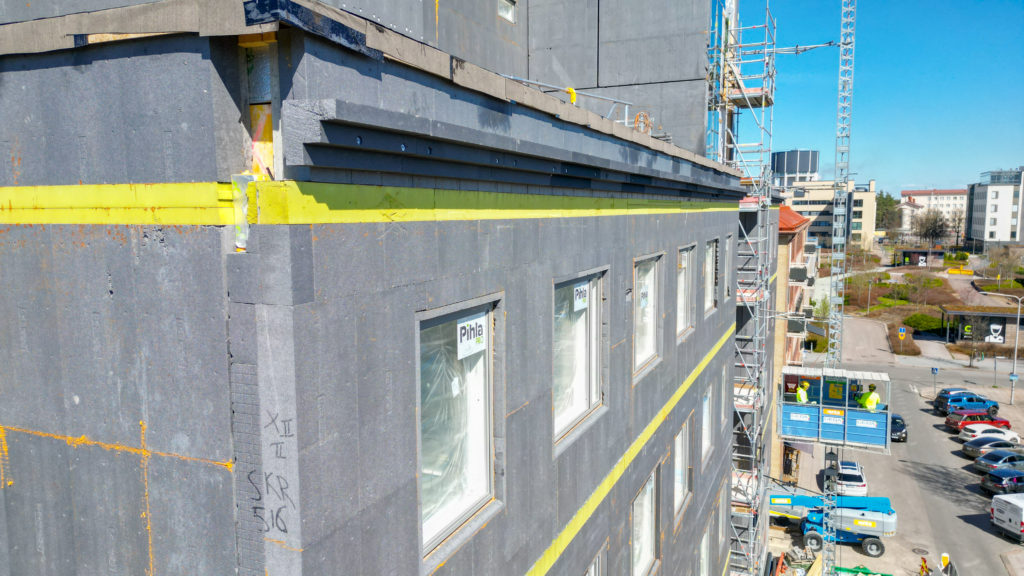
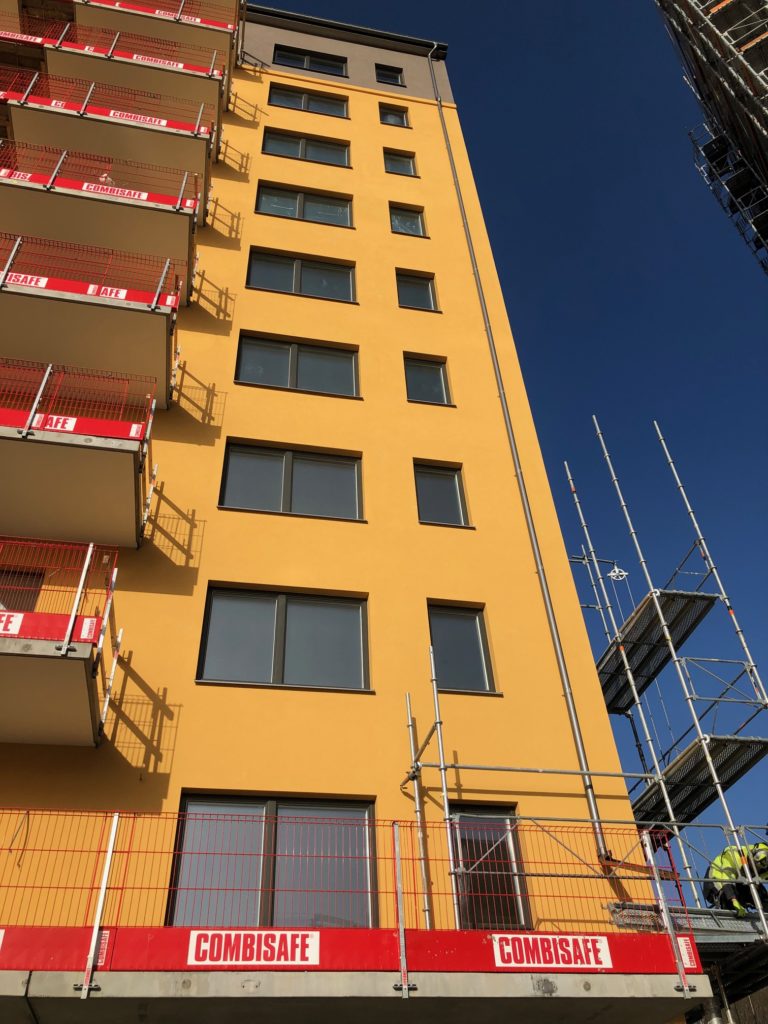
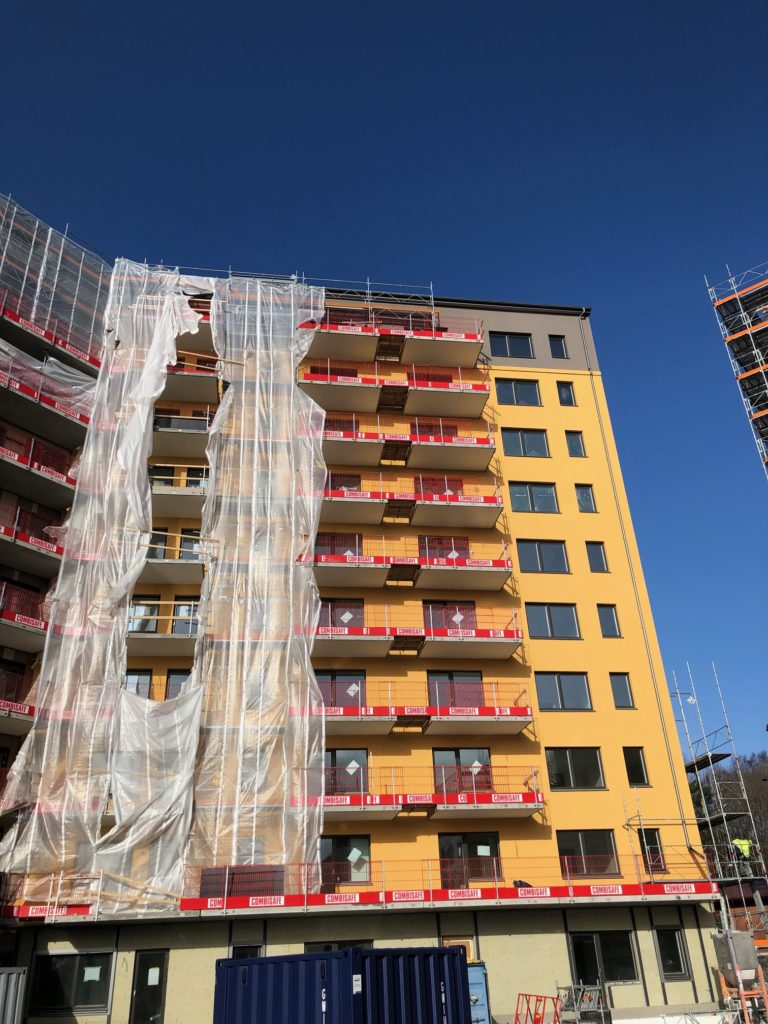
For a thin-coat rendered P1 fire class apartment building with a height of less than 28 meters, fire stops are created on every other floor 200 mm of FF-PIR insulation.
FF-EPS 60 S is a cost-effective thermal insulation product for walls that offers safe moisture performance and has a declared thermal conductivity (λD) of 0.031 W/mK. FF-EPS insulation products are suitable for new construction, low-energy, passive, and zero-energy construction, as well as for supplementary thermal insulation of older buildings.
FF-EPS 60 S insulation products can be used with various framework materials. Frames can consist of wood, steel, concrete, precast concrete, brick, lightweight concrete (Siporex), or breeze blocks. Structures that are thermally insulated with FF-EPS usually require a separate air or vapor barrier layer as the product does not have a high enough water vapor resistance to function as vapor barrier on its own. We recommend using elastic PU foam sealant for the seams and joints between panels.
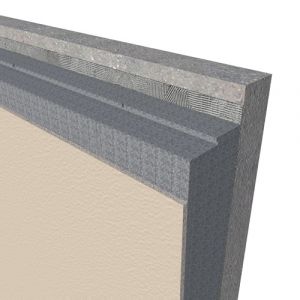
Custom-designed cornices to support the architectural design of the eaves of the building.
FF-EPS INSULATION PRODUCTS ARE SUITABLE FOR ALL WALL STRUCTURES
As a framework material for an exterior wall, rock (concrete, brick, breeze block) provides an excellent base for FF-EPS. The exterior surface of FF-EPS 60 S panels can be clad with wood facing, or thin-coat render may be applied directly onto the surface of an aged FF-EPS ETICS panel. FF-EPS insulation panels with locking tongue and groove are installed on the outside of the framework as a continuous layer of insulation by, for example, bonding the panels with mortar or attaching them with a PU foam adhesive to a supporting wall and securing the attachment with a few mechanical anchors. A concrete wall that is thermally insulated with FF-EPS insulation does not require an additional vapor barrier. The thickness of insulation is determined according to the desired U value. For example, a U value of 0.17 can be achieved with a 180 mm of FF-EPS insulation. To approach true zero-energy levels, walls should have a U value of at least 0.12, in which case the required insulation thickness is 250 mm.
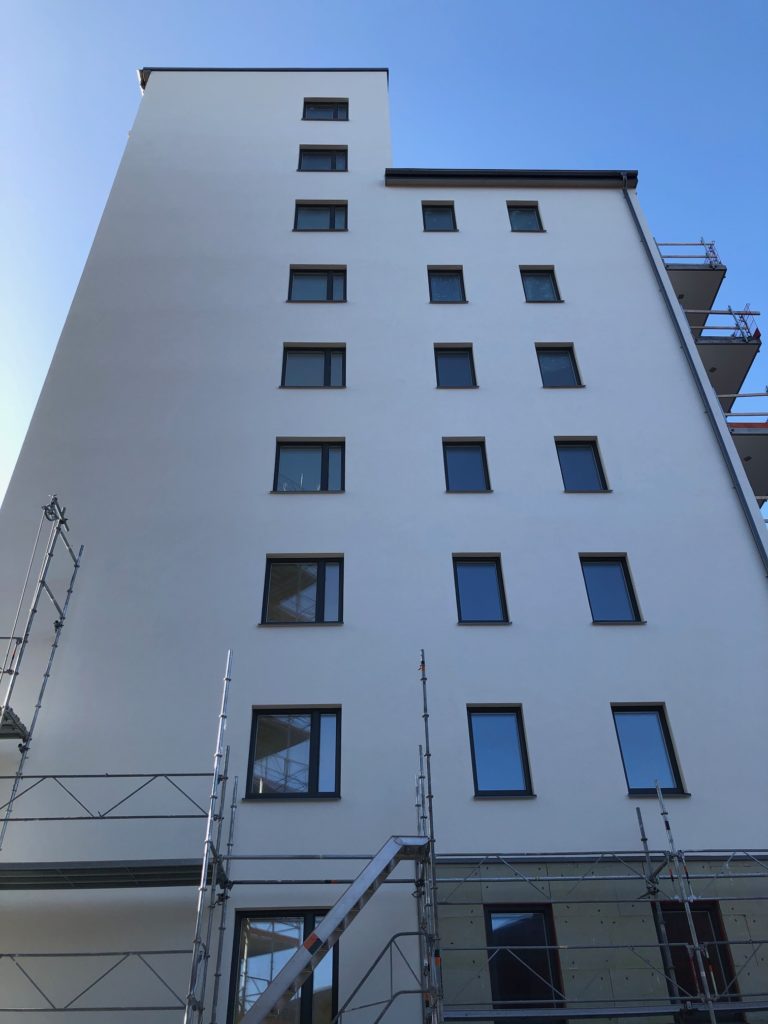
FF-EPS ETICS thin-coat render as base.
The framework of the exterior wall may also consist of wood, in which case the structure can be constructed as follows: FINNFOAM or FF-PIR thermal insulation panels are installed onto the interior surface of studs or between them, which also function as vapor barrier within the structure. A continuous layer of FF-EPS panels is installed on the exterior of the framework. The thermal conductivity of the layer of FF-EPS panels on the outside of a load-bearing framework must be as high or higher as that of the FINNFOAM or FF-PIR insulation in between the framework elements to insure correct moisture performance. The thickness of insulation is determined according to the desired U value. With a timber frame, the exterior face is constructed as a ventilated structure.
You can find more information on the properties of FF-EPS panels as well as the panel types and dimensions here.
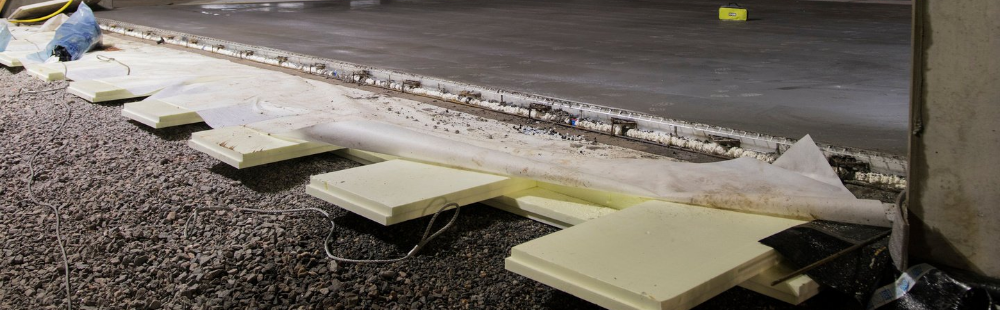
The high compressive strength and resistance to water vapor of FINNFOAM insulation products offer fault tolerance for base floor structures.
Using sturdy and waterproof FINNFOAM can significantly improve the performance of a slab-on-ground foundation and increase its resilience. The resilience of a structure is one of the most important guarantees for its functionality and durability. If the thermal insulation is installed under the slab, the structure will be significantly more resilient towards water damage, for example. With today’s increasingly thick base floor insulations, it is very important to ensure that the strength of the insulation is also increased in proportion. If this is neglected, the compression of the insulation will increase, leading to expensive repairs, as baseboards have to be dropped down and torn waterproofing in wet rooms will require mending. More information about these issues can be found below!
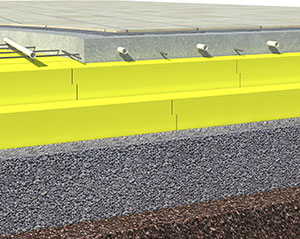
Today, the standard solution for slab-on-ground foundations consists of 2 x FL-300/100 mm. Correspondingly, 3 x FL-300/100 mm is used for structures with higher energy efficiency.
KEEP YOUR SLABS DRY!
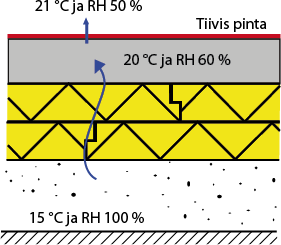
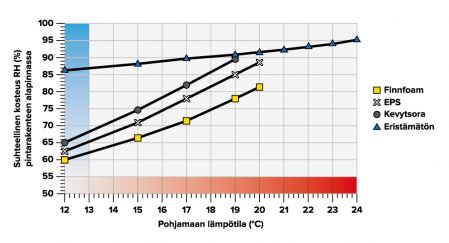
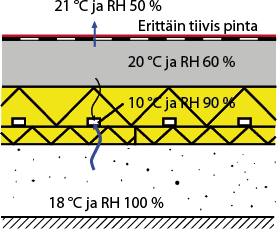
The relative humidity of the ground under the base floor insulation is always 95–100%. Thus, it is important to ensure that your thermal insulation has a high enough water vapor resistance and that it cannot become waterlogged. Waterlogged insulation will no longer function as designed, and it will also leave the poured floor moist, which may lead to indoor air issues. FINNFOAM is waterproof!
With proper thermal insulation, you can also avoid overheating the subgrade in small houses, where the construction span of the building is quite small. The risk of overheating will always be higher when underfloor heating is used. If the construction span of a building is increased, the amount of thermal insulation required will also grow. As FINNFOAM does not allow water vapor through, it provides time for the concrete slab to dry on the inside. Thus, the moisture content of the concrete slab is lower and the moisture performance of the structure is improved.
During a hot and humid summer, water vapor flows down toward the ground from the inside. This is why you should never place separate plastic vapor barriers between any of the slab-on-ground structures, as they reduce the moisture performance of the structure! To curb the flow of water vapor, thermal insulation should be highly resistant to water vapor, which is true for FINNFOAM. (Source: VTT and TTY).
With leak-proof coating, FINNFOAM can significantly improve the moisture performance of slab-ground foundations. Source: TTY – Virpi Leivo and Jukka Rantala
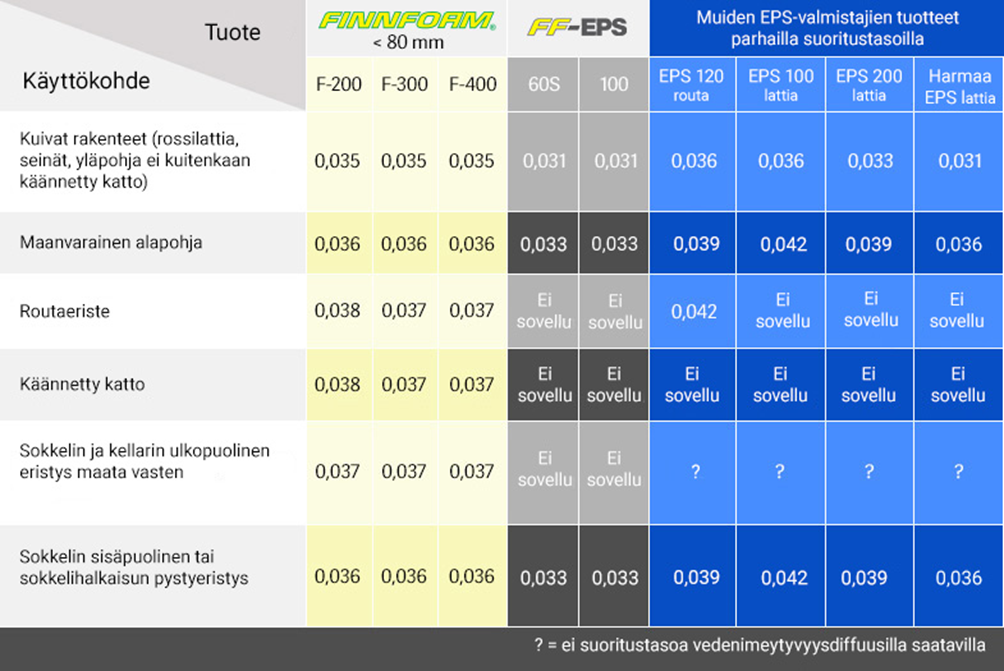
ACTUAL THERMAL CONDUCTIVITY IS DECLARED USING LAMBDA U UNDER RIL 225-2023
The declared thermal conductivity of thermal insulation and frost insulation materials (expressed as λDeclared) represents the optimal thermal conductivity of the product when dry. However, the design and dimensioning of base floor and frost insulation should always be carried out using the actual thermal conductivity of the products, i.e., lambda U (λU), which takes into account the detrimental impact of moisture on the thermal insulation capacity of an insulation product. To allow us to calculate λU values for insulation products used in the ground, we must know the water absorption of the product used when immersed, through diffusion, and after freeze-thaw resistance testing.
Below you will find lambda U values calculated for FINNFOAM and FF-EPS insulation products in ground-based applications, i.e., slab-on-ground foundations, vertical insulation on the inside or outside of foundations, and frost insulation. In addition, we have also listed actual lambda U values of other EPS insulation products used in similar applications for comparison.
The Lambda U values in the enclosed table have been calculated using the following formula based on the EN 10456 standard and the RIL 225 instructions:
λU = λDx FTx FMx Fa
λD = Declared thermal conductivity (Lambda), FT = Temperature conversion factor, FM = Moisture conversion factor, Fa = Aging conversion factor
DO NOT ALLOW THE SLAB TO SUBSIDE
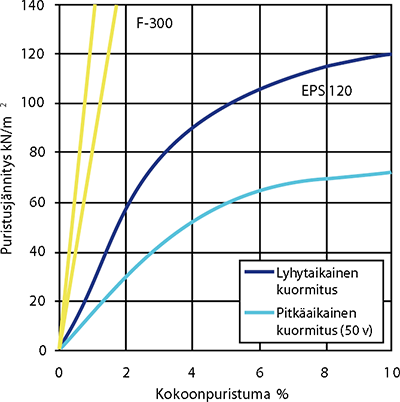
When the thickness of thermal insulation increases, the insulation must also be made stronger. Neglecting this will lead to higher subsidence. This is particularly emphasized today with growing base floor insulation thicknesses, as we are increasingly moving toward zero-energy houses. The following can be used as a rough guide for the sufficient strength class of floor insulation in residential buildings: With 100 mm of thermal insulation, the sufficient short-term compressive strength is 100 kPa, 200 mm insulation = 200 kPa, 300 mm = 300 kPa, etc.
The sturdy FINNFOAM has a very low subsidence, as it reaches its maximum strength (short-term compressive strength) at approximately 2% of compression, and thus its long-term compressive strength is also very high. FINNFOAM is also sturdy enough to be used for constructing solid thermal insulations under fireplaces and load-bearing partition walls. When used in floors, FINNFOAM insulation products are also highly resistant to point loads during construction without crumbling.
The long-term subsidence of FINNFOAM (F-300, 32 kg/m³) is less than one tenth of the subsidence of EPS materials commonly used in floors (EPS 120 20 kg/m³ or EPS 100 18 kg/m³).
COST-EFFECTIVE PANEL SIZE
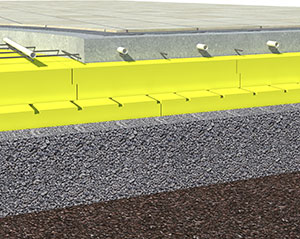
FINNFOAM insulation panels are highly resistant to the strains resulting from casting while constructing a split footing. As the sturdy FINNFOAM can be used to both insulate the footing and to construct molds for casting, the work is guaranteed to be efficient. The smooth surface of FINNFOAM allows it to be removed intact after casting as it does not stick to the concrete. On the other hand, if you want the insulation to adhere to the concrete, you should scratch or flute the surface of the FINNFOAM panels slightly. FINNFOAM insulation can be installed afterward on top of the footing using renovation mortar, for example. You can apply a thin coat of render on top of the FINNFOAM panels in accordance with the instructions provided by Fesco, for example.
The standard FINNFOAM panels are quite large at 2 500 x 600 mm, or 1.5 m2. The panels are still suitably sized and light enough for one person to handle, which means that their installation is cost-effective.
VENTILATED SLAB-ON-GROUND FLOORS
FINNFOAM can also be used for constructing ventilated slab-on-ground floors, where a compact network of ventilation channels is created between two layers of insulation. Even limited ventilation is enough to eliminate the water vapor load coming from the ground through the lower layer of FINNFOAM. The ventilation has no effect on the thermal insulation capacity of the structure. The ventilation channels must be produced in an uninterrupted manner.
Natural convection will generate a small amount of ventilation, which means that when ventilation is not needed in the summertime, its amount is reduced. Most of the radon moving up from the ground will also be removed through the same ventilation channels.
A ventilated slab-on-ground floor structure constructed with FINNFOAM will also work in larger buildings where the ground temperature is higher in the middle of the building. In addition, the surface material of the slab may be highly vapor proof. The structure will also reduce the radon risk.